05 November 2026 Admin
Saudi Arabia and Egypt are building a 3 GW electricity link. This is proof that cables can now shape trade as much as ships do. With the change in energy systems, it's obvious to rethink the conventional pipelines. Renewable energy corridors are networks, not just another single project. In this blog, we will look at their trade role between Türkiye, the GCC and the wider MENA.
What does Renewable Energy Corridor mean? A renewable energy corridor is much like a connected system and not any single project. It unites renewable generation, high-voltage transmission, storage, hydrogen or other energy conversion and cross-border flows with industrial zones, ports and trade infrastructure. It turns clean power into economic activity.
Reasonable and reliable power attracts factories. Factories need ports, roads and customers. That chain is the energy-to-trade multiplier. Regional Trade Connectivity grows when one investment pulls in many others.
One corridor has the capacity to connect generation, transmission, storage, hydrogen conversion, industrial zones, ports and regional markets. When it's done properly, it can:
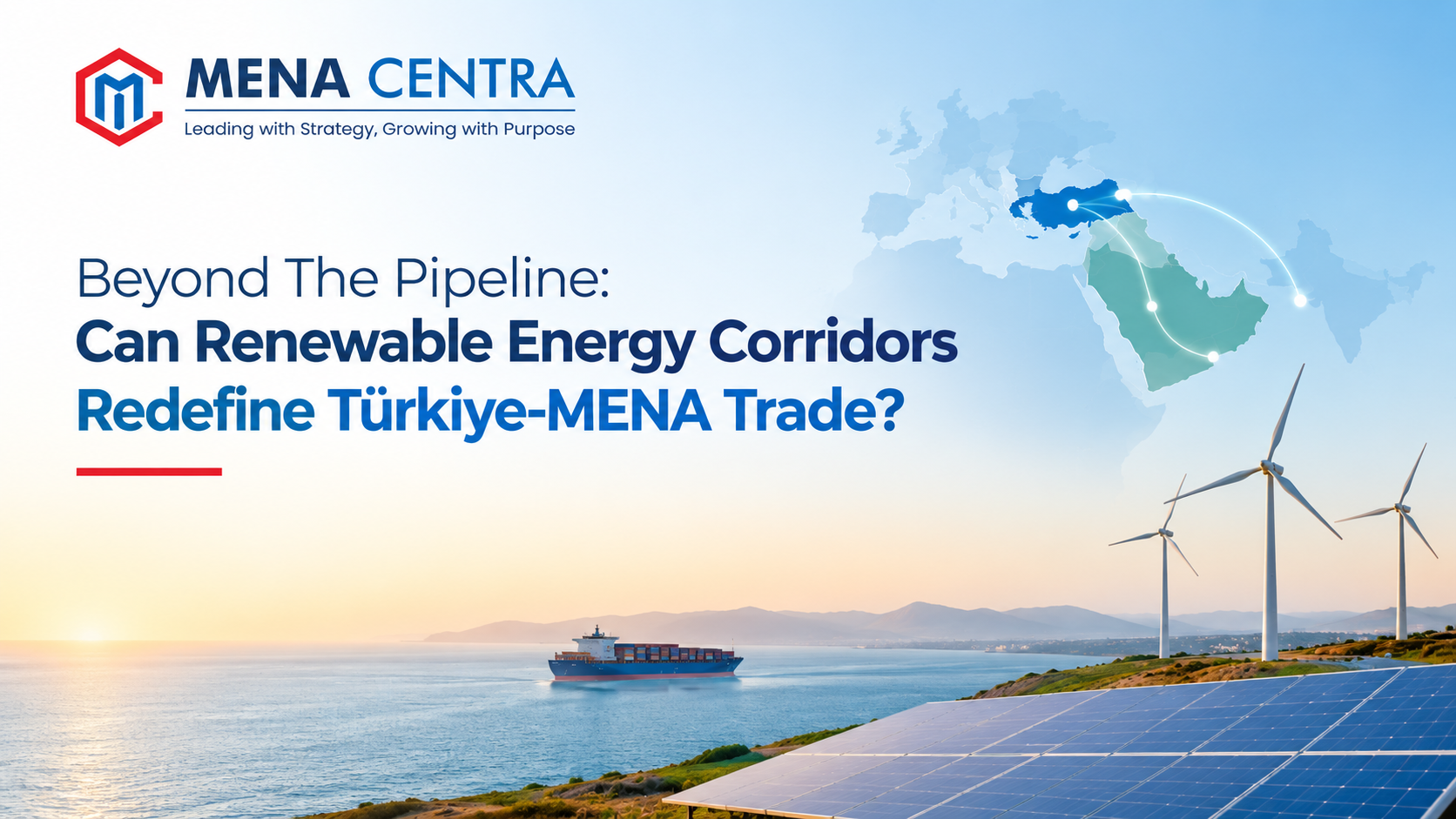
Look at the map and Türkiye’s role is easy to see. It sits where Europe meets MENA. It has serious manufacturing depth, and its ports and transport networks already work. Renewables also make up more than half of its installed power capacity.
That makes it a natural link between MENA energy production and European demand. But natural is not the same as guaranteed.
Hub status has to be earned and it depends on four things:
Building generation alone does not create a corridor. Renewable Energy Infrastructure must develop as a stack, with transmission, storage, conversion, logistics and market systems moving together.
|
Infrastructure |
What It Enables |
Strategic Requirement |
|
Solar & Wind Generation |
Clean Electricity Supply |
Competitive Renewable Resources |
|
Cross-Border Interconnectors |
Regional Electricity Trading |
Grid Compatibility |
|
Battery/Long-Duration Storage |
Supply Balancing |
Reliability |
|
Hydrogen Production |
Renewable Power Conversion |
Industrial/Offtake Demand |
|
Hydrogen Pipelines/Shipping |
Cross-Border Energy Movement |
Export Infrastructure |
|
Ports & Logistics |
Movement of Energy Derivatives/Equipment |
Multimodal Connectivity |
|
Digital Energy Systems |
Monitoring & Market Coordination |
Interoperability |
Cross-Border Electricity needs a Smart Grid to balance flows. Green Hydrogen needs buyers. Energy Storage keeps both reliable.
Three barriers decide whether a corridor stays on paper or reaches financial close.
Markets differ in structure, grid access rules, licensing, renewable-energy certification, hydrogen standards, guarantees of origin and power-trading rules.
Why Is Regulatory Harmonisation Important For Renewable Energy Corridors? Infrastructure can be physically connected yet commercially ineffective if markets cannot trade energy under compatible rules.
Projects crossing different jurisdictions face sovereign risk, currency exposure, long development periods, construction risk and offtake uncertainty. Guarantees and blended finance often bridge the gap.
Route disruption, infrastructure security and concentration risk all matter. The practical answer is diversification and resilience, not dependence on any single route.
The critical question is not “How much renewable capacity can be built?” It is who will buy the energy, through which infrastructure, under which regulatory framework, and with what revenue certainty.
It can be done with:
Most discussions stop at electricity exports. Türkiye-MENA Business Partnerships can create value across the whole corridor including manufacturing, logistics, technology and industrial clusters that form around reliable clean power.
|
Sector |
Potential Türkiye-MENA Cooperation |
|
Renewable generation |
Joint development and investment |
|
Grid infrastructure |
Engineering and infrastructure partnerships |
|
Green hydrogen |
Production, conversion and offtake |
|
Manufacturing |
Solar, wind, battery and grid-equipment supply chains |
|
Ports & logistics |
Energy-linked transport networks |
|
Digital infrastructure |
Smart-grid and energy-management systems |
|
Industrial zones |
Clean-energy-powered manufacturing |
How can renewable energy corridors improve supply-chain resilience? By spreading energy supply and transit across several routes and markets, they reduce dependence on any single point of failure and widen market access.
|
Factors |
Concentrated Route |
Diversified Corridor |
|
Transit dependency |
High |
Potentially distributed |
|
Energy supply exposure |
Concentrated |
Diversified |
|
Infrastructure failure |
Larger single-point impact |
More redundancy possible |
|
Market access |
Limited |
Multiple market connections |
|
Supply-chain resilience |
Lower |
Potentially stronger |
Diversification reduces concentration risk. It does not remove geopolitical, technical or regulatory risk.
Imagine it as a chain: renewable resources, generation, grid/interconnection, storage, hydrogen/energy conversion, industrial demand, ports/logistics, export markets. Success ot it can be measured by:
Capital and steel are the easy part. The hard part is getting the right people to agree, in the right order, under rules that actually line up. Most corridor projects stall there, not at the drawing board.
MENA Centra’s Strategic Partnerships and Economic Diplomacy ability fill that gap. It helps identify credible cross-border partners, bring public and private stakeholders to the same table and read regulatory and market conditions before any financial commitment. Then comes the real work of structuring partnerships and turning opportunities into programmes with clear owners.
For Türkiye-MENA Business Partnerships, this means connecting governments, investors and industry early. A project with shared ambition but unclear offtake or misaligned rules rarely survives. One with agreed roles and workable structures usually does.
Renewable energy corridors can become more than just power routes. Their larger value lies in connecting energy, infrastructure, industry, logistics and trade. Türkiye can potentially bridge MENA and wider markets if infrastructure and policy conditions align well, and GCC and MENA capital complements technology and industrial capability. Regional connectivity is best built when coordinated infrastructure and partnerships exist.