24 August 2026 Admin
The Middle East and North Africa (MENA) region has long been synonymous with oil and gas production. However, as the world faces the harsh realities of climate change, the nations of MENA are increasingly turning their attention towards renewable energy infrastructure.
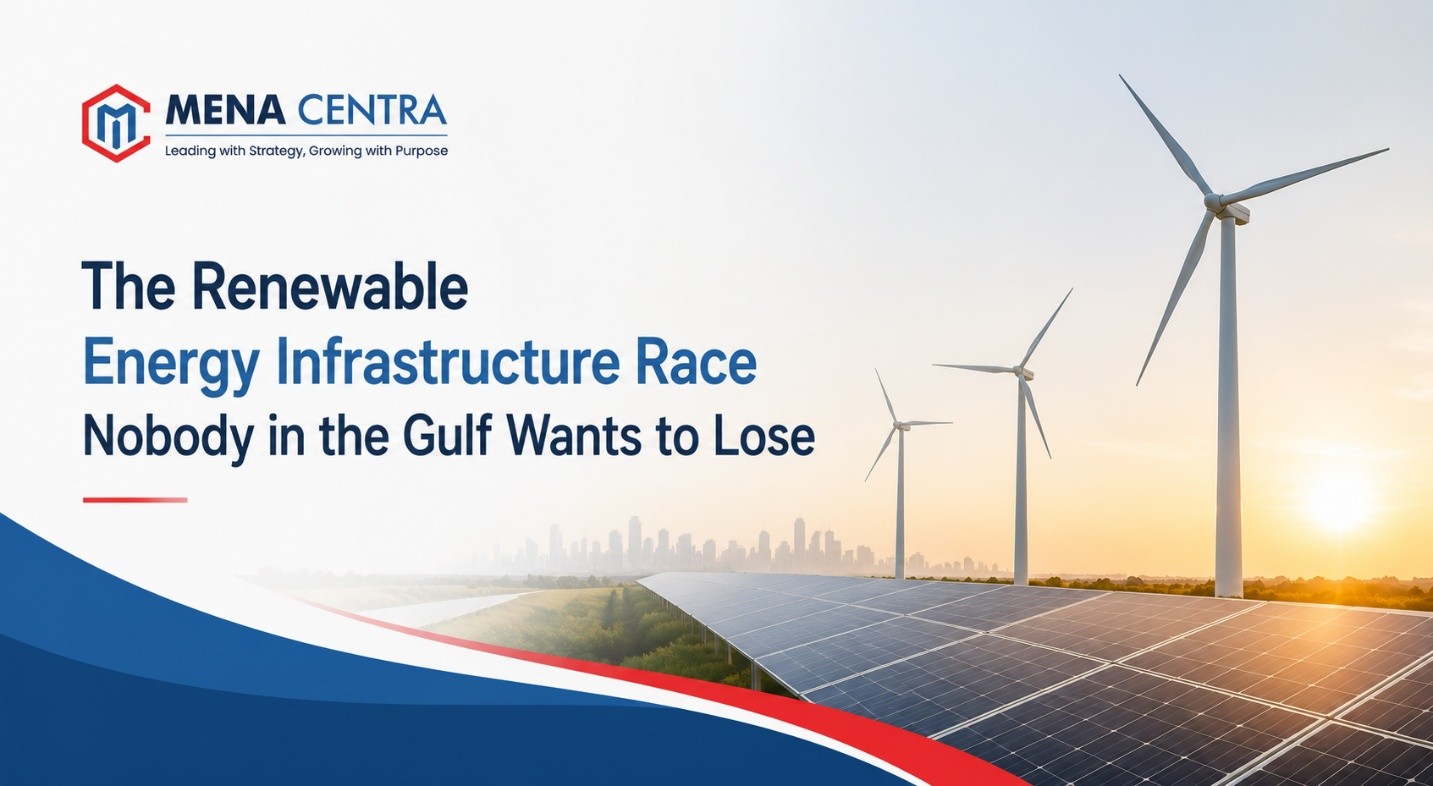
Drive through Riyadh, Abu Dhabi, or Doha today, and you'll see cranes doing more than reshaping skylines. They are building solar farms, wind projects, and grid substations at a pace that would have seemed unimaginable just a decade ago. The Gulf has entered a full-scale race to expand its renewable energy infrastructure, and none of its major players wants to be left behind.
This shift is about far more than meeting climate targets. It is about determining who will shape the region's next era of economic and strategic influence. Oil defined the Gulf's first chapter of global power. Renewable energy infrastructure is laying the foundation for its second.
Across the Gulf, renewable energy infrastructure has become more than an environmental priority. It has evolved into a strategic race for long-term economic influence and energy leadership. Saudi Arabia's NEOM and its ambitious green hydrogen plans, the UAE's continued expansion of solar power through Masdar, and Oman's growing investment in wind energy are not just standalone national projects. Together, they reflect a broader regional push to secure a leading position in the clean energy economy as global demand for fossil fuels gradually levels off.
What sets this wave of investment apart from previous infrastructure booms is the way it is being planned. Instead of building first and optimizing later, governments and utilities are relying on a data-driven growth strategy to guide every major decision. From identifying the best locations for solar farms to determining storage requirements and designing efficient transmission networks, data is driving smarter investments. Satellite irradiance mapping, demand forecasting, and real-time grid analytics are providing the insights needed to maximize performance while minimizing costs.
This approach is essential because renewable energy infrastructure leaves little room for error. A solar farm built in the wrong location or a grid that cannot reliably manage variable power generation can quickly turn into a costly mistake. A data-driven growth strategy helps reduce these risks by ensuring projects are based on accurate demand, resource availability, and long term system performance. As renewable energy investments accelerate across the Gulf, data is becoming the key factor that separates successful, scalable projects from those that struggle to deliver on their promise.
The conversation around renewable energy infrastructure extends beyond government ministries and global climate summits. Some of the most important groundwork for regional energy cooperation is happening through Track II diplomacy in Turkey, where informal dialogue is helping shape ideas long before they reach official negotiating tables.
For those unfamiliar with the term, Track II diplomacy refers to informal dialogue between former officials, academics, and industry figures, operating outside official negotiating channels but often feeding directly into them. Istanbul and Ankara have emerged as important hubs for these conversations. Positioned at the crossroads of the Gulf, the Levant, and Europe, Turkey offers a strategically neutral setting where stakeholders from across the region can engage in dialogue without the political sensitivities.
These informal channels are where ideas about cross-border grid interconnection, shared hydrogen export corridors, and joint renewable energy infrastructure financing first get tested. Nothing here is binding. But by the time a proposal reaches an official summit, it has usually already survived a round of scrutiny in exactly these rooms.
Taken together, these developments reveal a clear direction for the region. Gulf states are accelerating investments in renewable energy infrastructure while relying on a data-driven growth strategy to ensure those investments are efficient, resilient, and built for long-term success. At the same time, Track II diplomacy in Turkey is quietly fostering the cross-border dialogue needed to turn national ambitions into regional collaboration.
The transition will not be without challenges. Financing constraints, supply chain bottlenecks affecting solar panels and wind turbines, and long-standing geopolitical rivalries could all slow progress. Yet the momentum is undeniable. The countries that view renewable energy infrastructure as a long-term strategic investment, rather than a short-term political milestone, will be best positioned to lead the region's next era of economic growth and energy security.
The Gulf's renewable energy transition is no longer a distant ambition. It is unfolding now, driven by strategic investments, data-driven planning, and growing regional collaboration. While challenges remain, the countries that combine long-term vision with smart infrastructure decisions will be best positioned to shape the region's future energy landscape.
At MENA Centra, we explore the policies, partnerships, and geopolitical developments driving this transformation across the Middle East and North Africa. Follow our latest insights to stay informed on renewable energy infrastructure, regional trade, and the strategic trends shaping the future of the MENA region.
It includes solar farms, wind installations, transmission grids, battery storage, and increasingly green hydrogen production and export facilities.
It helps planners choose better sites, size projects accurately, and avoid the wasted spending that comes from guesswork.
It is informal dialogue between non-official figures like academics and former officials, used to explore ideas before they reach formal negotiations.
Its geographic position connects the Gulf, Europe, and the Levant, making it a neutral space for cross-regional energy discussions.
Saudi Arabia and the UAE are currently the most visible, though Oman and Qatar are expanding their own programs as well.