24 September 2026 Admin
Women’s economic participation in Türkiye has been rising, entrepreneurship is expanding, and women are increasingly present in the country’s green and digital transformation. Yet the numbers also reveal considerable untapped potential, and an opportunity that extends beyond Türkiye to its economic relationships with the MENA region and Europe.
Türkiye’s economic landscape is changing, and women are becoming an increasingly visible part of that transformation.
Recent figures on entrepreneurship and new businesses, together with initiatives connecting women to Türkiye’s industrial, green and digital transformation, tell an encouraging story. Women are increasingly establishing businesses, entering new sectors and being recognised as entrepreneurs, producers, innovators and agents of economic change.
According to the Union of Chambers and Commodity Exchanges of Türkiye (TOBB), women represented 15.7% of shareholders in newly established incorporated companies in July 2026 and 17.1% in newly established limited liability companies.
Their presence was even higher in newly established cooperatives, at 22.1%, while women established 15.5% of new sole proprietorships during the month.
These figures matter beyond representation. They tell us something about the changing composition of Türkiye’s private sector, and about an entrepreneurial resource that could play a significantly larger role in future economic growth.
The challenge now is not only to increase the number of women starting businesses, but to enable more of these businesses to survive, grow, formalise, innovate, employ others and eventually reach regional and international markets.
Digitalisation, artificial intelligence, changing global supply chains, the green transition and new sustainability requirements are reshaping how companies produce, trade and compete. Türkiye’s position between Europe, the Middle East and Asia makes these transformations particularly important.
The question is therefore not only how many women participate in the economy, but where and how they participate in the industries of the future.
A recently concluded three-year initiative implemented by UNDP and the Turkish Confederation of Employer Associations (TİSK), in cooperation with Türkiye’s Ministry of Industry and Technology and funded by the European Union, offers an interesting example.
Working across nine provinces, the programme connected women’s economic participation directly with the digital and green transformation of manufacturing. It trained 488 women, supported 351 women into employment, delivered 515 mentoring sessions, and worked with companies on digital and green transformation assessments.
Perhaps more importantly, the programme developed an “Equality in Twin Transformation” model, integrating gender equality into thinking about digital and green industrial transformation.
This represents an important shift in perspective.
Women should not be viewed only as beneficiaries of economic development. They are entrepreneurs, engineers, farmers, producers, designers, managers and investors who can actively shape how economies transform.
But other figures deserve equal attention. Together, they reveal an interesting combination: growing momentum alongside considerable untapped capacity, which may represent one of Türkiye’s most important economic opportunities.
The distinction matters. Labour-force participation includes women who are employed and those actively seeking work; it does not mean that 36% of women are currently employed.
It is also important that these figures are not limited to formal employment. Türkiye’s household labour-force statistics capture economic activity beyond formally registered jobs, including self-employment and unpaid family work. This is particularly relevant for women, whose economic contributions can be less visible in agriculture, family enterprises and small-scale economic activity.
Informality remains a challenge. ILO data have estimated that approximately one-third of employed women work informally, often without the social protection and security associated with formal employment.
The longer-term direction, however, has been upward. Women’s participation in Türkiye’s economy has expanded significantly since the early 2000s, even though a substantial gender gap remains.
The economic question, therefore, is not simply how to bring more women into the labour market. It is how to translate this growing participation into formal employment, entrepreneurship, productivity, business growth and economic leadership.
If women’s entrepreneurship is to become a significant driver of economic growth, supporting individual businesses will not be enough.
The larger opportunity lies in creating an ecosystem in which women-led enterprises can grow.
That requires better connections to finance and investment, mentorship, technology, digital capabilities, markets and business networks. It also means connecting entrepreneurs with established companies, universities, financial institutions, municipalities, investors and policymakers.
There is particular potential in sectors where Türkiye already has competitive strengths and where women are active or could become more active: textiles and apparel, agriculture and food production, tourism, design, cosmetics and personal care, manufacturing, technology, creative industries and the green economy.
Formalisation should be part of this conversation as well. Helping women move from informal or micro-level economic activity towards registered, sustainable businesses can increase access to finance, social protection, investment, export opportunities and larger markets.
Across the MENA region, women are building businesses, managing family enterprises, establishing start-ups, producing locally and developing new products, often while encountering similar constraints around financing, networks, market access, visibility and opportunities to scale.
Türkiye can provide an important bridge.
Its manufacturing base, entrepreneurial ecosystem, geographical position and extensive commercial connections with both Europe and the Middle East create opportunities to connect women entrepreneurs across markets rather than considering women’s entrepreneurship exclusively within national borders.
Imagine stronger networks connecting a Turkish textile producer with a Jordanian designer; a women-led food enterprise with Gulf markets; an Anatolian agricultural producer with a regional cosmetics brand; or technology entrepreneurs in Türkiye with partners and investors across MENA.
These connections turn women’s economic participation into regional value creation.
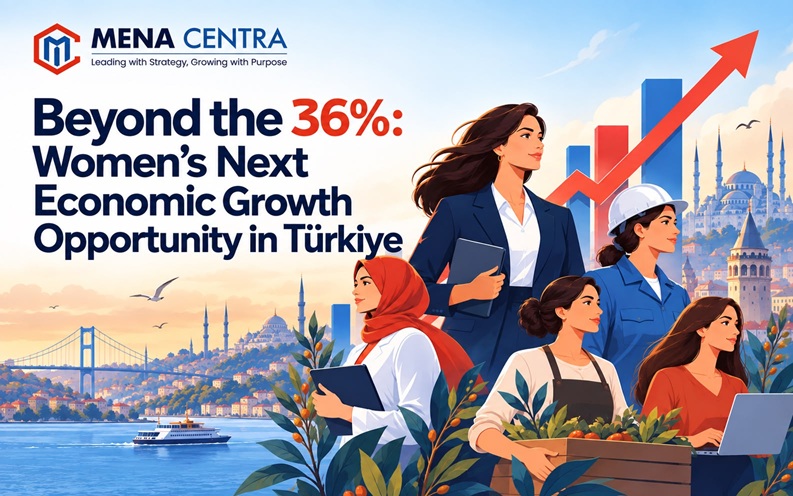
Moving women’s labour-force participation beyond today’s roughly 36% matters. But numbers alone should not define success.
The bigger opportunity is to ensure that more women can move from participation to productivity, from informal activity to formal enterprise, from micro-businesses to growing companies, and from domestic markets to regional and global value chains.
For MENA Centra, this is where the conversation becomes particularly interesting.
As a platform focused on linking markets, growing businesses and shaping futures, we believe that stronger connections among women entrepreneurs, established businesses, investors, producers and markets across Türkiye and the MENA region deserve greater attention.
Women’s growing presence in Türkiye’s business landscape is therefore more than an encouraging statistic. It invites a much larger economic question:
What could Türkiye and the wider region gain if the business potential, knowledge and creativity of millions more women were connected to finance, technology, markets and opportunity?
The answer may be one of the region’s most promising, and still largely untapped, sources of growth.